Signed in as:
filler@godaddy.com

Yakama Tribe
Yankton Sioux Tribe
The Sheridan Press, Saturday, October 15, 2022 137thYear, No. 133
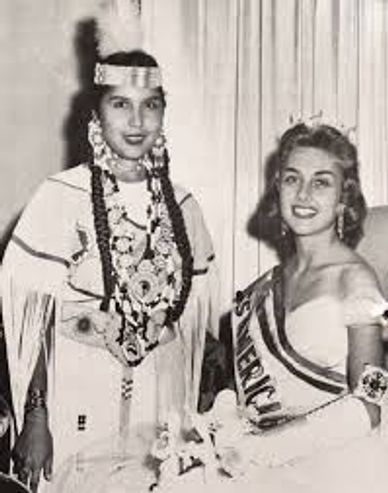
SHERIDAN -The oldest living Miss Indian America, crowned in 1954, is being featured in the nation’s largest mural and is continuing her work at Sheridan’s Kendrick Park Arboretum.
Marly Louise Defender-Wilson, a member of the Miss Indian America Collective, was born Oct. 14, 1930, near Shields on the Standing Rock Indian Reservation in North Dakota. She is a member of the Dakotah/Hidatsa people, and her cultural work as a storyteller, traditionalist, historian, scholar and educator has been globally recognized.
A key moment in her journey, she said, took place in Sheridan almost 70 years ago.

“All American Indian Days was like a wake up call to me to be interested in who I am, as a person of this land,” she said. “I’ve made it my business all my life to look at all the things about myself as a person, and it work me up to using my own language.”
This summer, the MIA Collective spearheaded a tree-planting project at the Trail End Arboretum, planting 15 trees to pay tribute to the historic All American Indian Days, held from 1953-84, which included the Miss Indian America Pageant. Over many decades, Defender-Wilson has worked to bring awareness about her people to the nation. Today, her portrait is one of three featured in the largest mural in the United States, the Glass City River Wall in Toledo, Ohio. The Glass City River Wall is a community project, and no one in the Unted States has ever painted a mural of this size, deana harragarra waters, crowned Miss Indian America in 1975 and a member of the MIA Collective, said.
"In that regard, it is (similar to) what Sheridan accomplished in the 1950s with All American Indian Days and the Miss Indian America title," harragarra waters said. "Until then, no one in the United States had ever created an inter-racial project in human relations with Indian women leading the advocacy for unity and understanding among all peoples."
Defender-Wilson's life connects these two vital commw1ity projects transcending decades, she continued. Throughout the decades, her commitment to the Sheridan community continued, and lives on in her membership in the
MIA Collective. harragarra waters first met Defender-Wilson, in 1975 at the 22nd Miss Indian America Pageant.
"She was one of the first Indian people to serve as a judge, until then an all-white panel of judges selected the winner," harragarra waters said. "l will always remember her telling me how her Santee people were closely related to my Otoe people."
The Glass City River Wall project will celebrate its completion this weekend in a live-streamed event in Toledo, with DefenderWilson in attendance alongside Bear Dancers, Buffalo Dancers and other family members.
"It's really rare to see Bear Dancers, even on the reservation," said Christina Kasper, pro} etc. manager for the mural. "For me, the world is going to stop for a little bit when they are here."
Defender-Wilson was chosen to be a part of the Glass City River Wall by the artist, Gabe Gault.
"He was looking for reference photos in National Geographic, and came across a picture of her," Kasper said.
The photo was taken by Rev. Don Doll, a Jesuit priest known for taking photos of Native Americans and others during his spiritual work over the last 50 years. He connected the artist with Defender-Wilson, and things took off from there.
"You can see something in her face. 82,365 vehicles pass that spot a day. It is on l-75 and l just, every time I pass it, without fail, I look at her," Kasper said.
The Glass City River Wall is the largest mural in the country by 100,000 square feet. When work began before the pandemic, representatives from Toledo's Arts Commission found a historic marker on site commemorating the fact that the location was once a Native American fortification. The mural grew from there.
Not only was it important to remember the history on site, but Kasper said it was also important to depict the people in the mural as living members of society.
"It was really important that those (in the) portraits have contemporary clothing on, and that all the models are live models. It was said to us very, very early on that people view Native Americans as a people of the past. But they also said, 'We live an1ongst you. We are a people of the past, present and future. We still contribute on a sizable level,"' Kasper said.
The mural sits at a bend on the east bank of the Maumee River, where visitors can see a mile in each direction.
"I say all the time that this project spoke to us. We were just the vessels to make it come true," Kasper said.
There are three big grain silos at the end of the site selected for the mural, which were perfect for portraits, she explained.
"The overarching component here is, 'Whose story is told, and why?' We want to connect the community, but also to tell the story of this history. It is not ours to tell, but this was a way to tell that story," she said.
Defender-Wilson said she was drawn to the mural project first because of ADM grain silos.
"I thought the silos represent grain," she said. "One of the sponsors feeds people all over the world, and that represented us, and how our people were here for so long, and first. The Lakota-Sioux people were gardeners, and we fed people."
In a more localized way, the MIA Collective is doing similar commemorative work in Sheridan. According to Judy Slack, who serves as a liaison between the MIA Collective and the local commw1ity, two donors have committed a park bench for the arboretum project, and plans for a bronze plaque commemorating the women and a large stone for its display are underway.
"Our goal is to plant 30 more trees next summer, along with several bushes," Slack said.
Defender-Wilson, whose recording of the Star in the Cottonwood story can be heard on YouTube, said she hopes that next year, the arboretum will include a cottonwood to commemorate the origin story of the star inside a cottonwood branch, long told by her people. Clark Van Hoosier, city arborist for the City of Sheridan, said that the plan is to plant a cottonwood tree next year in a second round of trees.
"Next year, along with additional tree plantings, the MIA Collective is also planning for the installation of a bench and memorial plaque at the arboretum. One of the ideas we have discussed is placing a sign next to the cottonwood telling the Dakota Legend. It's great lore, and the Plains cottonwood is also Wyoming's state tree, so an installation of the tree makes too much sense to not pursue in the future," he said.
The MIA Collective will work with the city to install signs and QR codes to commemorate the Miss Indian Americas, and All· American Indian Days board members, host families and participants. The MIA Collective is also working with an online museum to host the All American Indian Days and MIA history, along with videos and photos.
"The website will share the (Glass City River Wall) mural, in which an important Miss Indian America Collective member, is being featured," Slack said.

Photo by Judy Slack

Hunkpapa Sioux Tribe
Skidee Pawnee Tribe
Gros Ventre Tribe

Blackfeet Tribe
Diné Navajo Tribe
Walla Walla, Yakama, and Northern Cheyenne Tribes
Kalamath Tribe
Sisseton Yankton Sioux Tribe
Watch this 18-minute documentary Cheyenne Autumn Trail, which features Willi Youpee.
Northern Arapaho Tribe
Kiowa Tribe
Taos Tribe
Diné Navajo Tribe
Crow and Skidee Pawnee Tribes
S Cheyenne, S Arapaho, Diné and E Sioux Tribes
Cherokee of OK and Mvskoke Tribes
Diné Navajo Tribe
Shoshone Bannock Tribe
Tohono O'odham Tribe
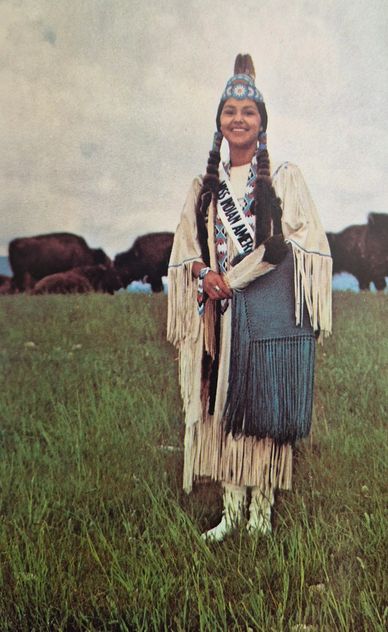
Photographer: Archie Nash from Sheridan, WY
Taken at the beginning of my reign 1974
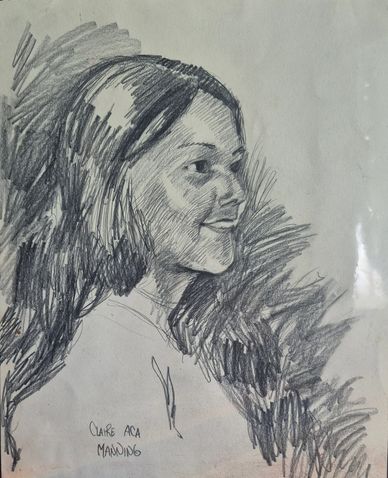
Artist: William E. Wright from Sheridan, WY. 1974
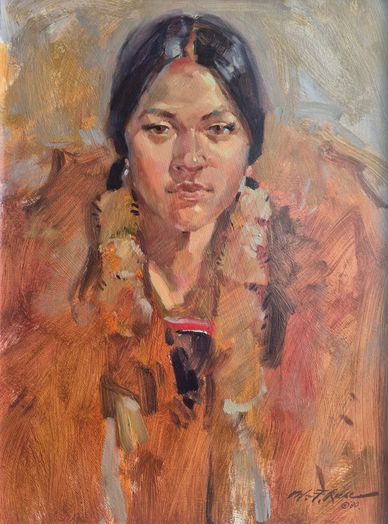
By William F. Reese from the state of Washington. (My Shoshone Tribal Name is Aca - Yellow Sunflower) 1975

BY STEPHEN DOW
SHERIDAN — It’s been nearly 50 years since Claire Manning-Dick served as the 21st Miss Indian America, beginning in 1974. But the memories of the experience stick with her, as does the generosity of the Sheridan community.
“I really liked Sheridan because the people there were so generous,” said Manning-Dick, a member of the Shoshone-Paiute tribe. “If there’s one thing I took away from my time there, it’s to always give to others and always know that life is short. While we’re here on Earth, we need to serve others and do what we can to help before it’s our time to go.”
That message of service has been passed onto Manning-Dick throughout her life, especially by her family. Her grandfather fought in six campaigns near the French border in World War I. Her father served in Pacific campaigns in World War II and helped protect the Native American code talkers during the war. Her husband served in the Vietnam War and eventually died from service-related injuries in 2010. Throughout her life, Manning-Dick has been surrounded by people who have made sacrifices for the country they love. And in her own way, she is carrying on the tradition.
Following the death of her husband, Manning-Dick joined the Gold Star Wives of America, a national organization that exists to “preserve and enhance benefits to surviving U.S. military spouses and children; to help our members and their children face the future with courage and determination; and to honor the memory of our military spouses who made the ultimate sacrifice,” according to the organization’s website.
Manning-Dick has spent the last decade rising through the ranks of the organization and now finds herself on a national platform to advocate for the surviving spouses of veterans.
She is currently serving as the organization’s president, has testified before U.S. Congress and recently had a chance to meet President Joseph Biden. She placed a memorial wreath at the Tomb of the Unknown Soldier in Arlington National Cemetery on Memorial Day this year and will do the same this coming Veteran’s Day.
It’s all been a wonderful journey, Manning-Dick said, but one that’s continually rooted in her passion to serve the families of veterans.
“I understand personally the sorrows and problems of service spouses,” Manning-Dick said. “I understand the things they need help with when a child loses a parent.
“I understand the things they need help with when a child loses a parent. My main concern is to be available for spouses and to answer any questions or concerns they have. When they have no other place to turn, I want to be the person they turn to.”
Manning-Dick said she has several priorities as president of the organization, including connecting military families and spouses with health benefits and insurance. The group is also working to prevent military suicides and is involved with the crafting of legislation that betters the lives of both veterans and their families, Manning-Dick said.
For example, Manning-Dick spoke before the Joint Senate and House Committees on Veteran Affairs in March 2022, and identified priorities on which her organization wanted the committees to focus. These included increasing dependency and indemnity compensation — the flat monthly rate given to surviving spouses of veterans, which has not been increased since 1993, outside of minimal cost-of-living increases.
“Since 1993, surviving spouses of military veterans have found themselves falling further and further behind in meeting their financial obligations from month to month,” Manning-Dick said in her testimony given March 8, 2022. “Many surviving spouses of the World War II, Korea, and Vietnam eras are receiving only DIC; some receive DIC and minimum Social Security benefits. These DIC recipients struggle monthly with their budget of $1,437.66, juggling bills to meet the rising costs in housing, utilities, food, clothing and other personal living expenses. This scenario can lead too often to homelessness, a plight we do not wish to befall anyone, and least of all the surviving spouses of our military veterans.”
In addition to the hard work Manning-Dick does fighting for military spouses and families, the leadership role also gives her a unique platform to honor veterans, as she did on Memorial Day in Arlington. That same day, she had a chance to meet with veterans and President Joseph Biden. She also attended the National Memorial Day Concert on the Capitol lawn, which was broadcast on PBS.
“It was an honor to meet some of our war veterans, including some World War II veterans,” Manning-Dick said. “They reminded me so much of my dad and uncles who served. As far as President Biden, I got to shake his hand and thank him. He was very kind and told me ‘Native American veterans have given so much for our nation.’ I really appreciated him saying that. I’m really proud of how our Native American veterans have served our country over the last 200 years. We are a very patriotic people.” While not everybody has the kind of platform she has, Manning-Dick encouraged everyone to take time to celebrate the Veteran’s Day holiday, and to thank those who served, and those who were left behind.
“Veteran’s Day is not only happening in the Capitol, it is happening in every local community, including Sheridan,” Manning-Dick said. “I really encourage people to go out and celebrate and to honor and protect one another.”
Manning-Dick encourages anybody who lost a spouse who was killed or missing in action or died from service-related disabilities to reach out to the Gold Star Wives national office at 1-888-751-6350. For more information on the organization, see goldstarwives.org.

BY JOSEPH BEAUDET
SHERIDAN — The camaraderie and brotherhood between veterans is unique, said Beth Martini, the chief of mental health at Sheridan Veterans Affairs Health Care System. “...The service that they provided was a service that (was) for a greater purpose than themselves and that in and of itself is a connection that we can’t expect veterans to have with civilians,” Martini said. “Their purpose in serving was so specific and so close knit that their connections with one another are lifelong.”
Maintaining those strong connections among veterans is what recently inspired Liz and Clayton Morris to start a Facebook group to connect veterans in the area to each other. By cultivating a welcoming environment, the group has helped foster unique connections among veterans because of their military service.
Julie Heid, a veteran in the Facebook group, said veterans have connected through several avenues, including finding civilian jobs after serving.
“Other veterans — we get that, and we’ll understand that part,” Heid said. “There’s a lot of things about having served in the military that only a few people understand, that only a few people can get.”
Now sitting at 136 members, the Sheridan WY Area Veterans group was started in 2022 in an effort to organize more family-friendly gatherings for veterans.
“We wanted to be able to get like-minded people together for Veterans Day or barbecues, or sometimes we’ll go do a lake day or anything like that where you can get families involved,” Liz Morris said.
They have gathered the area’s veterans in a variety of ways over the last year, including a Christmas party, Vetsgiving and a trip to the Tongue River reservoir.
The group is very relaxed and welcoming, in part because veterans in Wyoming are a “different breed,” Morris said. She added veterans, and many Wyomingites in general, tend to keep to themselves.
Heid said the transition from military to civilian life can be difficult for veterans, so being around others who have already made that transition can be valuable.
“A lot of us have made that transition (to civilian life) and a lot of us have joined the civilian workforce now,” Heid said. “So, we are here to help veterans not only get back into civilian life and get those jobs, help with resumes, things like that but just offering support.”
While the group started in an effort to connect veterans, volunteerism around the county quickly blossomed. Some of the volunteer efforts among the veterans have included filling sandbags several times and helping people move.
“We’re so used to service,” Liz Morris said. “So, even being civilians now, it feels natural for us to pitch in.”

BY CAROLINE ELIK
RANCHESTER — Servicemen from Wyoming were among the first and last casualties of the U.S. war in Afghanistan. Army Spc. John J. Edmunds of Cheyenne was one of the first to die in 2001 in Pakistan, while Marine Corps Lance Cpl. Rylee J. McCollum of Jackson was killed in 2021 in Kabul just before the U.S. fully withdrew troops from the country.
Tongue River Middle School students are keeping that personal tie close to their hearts as they continue a tradition of honoring local veterans.
Cody Koch, TRMS social studies teacher, helps coordinate the school’s Veterans Memorial Wall and Veterans Day projects.
It’s his second year teaching at TRMS, and his second year coordinating a letter-writing program. Koch’s students — about 100 of them — show their appreciation for Sheridan County veterans by sending them handwritten letters.
For students, the letter-writing project is a way to show their appreciation for veterans in a way that allows them to reach hundreds in the community, even veterans they don’t know personally. TRMS eighth-grader Addie Perkins said by her count, students sent around 225 letters to local veterans this year — a significant increase from 2022, when students wrote around 180 letters.
“[Veterans] are really selfless people … they go out and know that they can die for everybody else, but we can keep our freedom because of them,” Perkins said.
Each student typically writes multiple letters, some as many as 30. In previous years, classes of students have dedicated significant efforts to planning the creation of the Tongue River Valley Veterans Memorial wall, which was funded entirely through charitable donations and is located on the lawn of TRMS. The wall was presented to the community at a ribbon cutting ceremony in June, and since it is now largely
completed, Koch said this year he wanted students to focus on making veterans feel appreciated in an individualized way. Koch said he gathered a list of names of veterans from Sheridan’s Veterans of Foreign Wars post, the American Legion, TRMS staff and his students, who were given the option to also write letters to their own friends or family members. Then, once completed, Koch sent them off to be delivered.
Though the main goal of the letter writing project is to express appreciation for veterans, Koch said it also has the added benefit of providing students with an opportunity to practice reading, writing and life skills.
“Obviously there are some academic things that go along with this too. How to write a letter, how to address it, how to fold it,” Koch said. “So we're attaching some learning with that as well.”
Perkins and seventh-graders Kobbe Smith and Emellia Winfrey are three of those students.
Each of them strongly value those who serve, and said their beliefs helped influence the letters they wrote.
“They went out there knowing that they could die, but they're doing it for their country,” Winfrey said. “When you get a letter, it's
heartwarming … and it's kids writing to them, so it's even bigger.”
Smith agreed in particular that receiving letters from children makes the project warmer and more special.
“I'm grateful for them because some of them sacrifice their lives for people that they don't know. They don't always get all the gratitude they deserve,” Smith said. “So I think for them, it’s cool to get letters from kids.”
Students write several letters and make each of them unique so each veteran gets a special, individual thank-you. Perkins, Smith and Winfrey also said they each invited veterans to the TRMS Veterans Day assembly, which is held at the school every November. Veterans and the community are invited to attend to listen to the school choir sing, watch students read Patriot Pen essays and visit the Veterans Memorial Wall.
“I had a lot of veterans come up to me after the assembly last year, and then they went out and looked at the memorial … and they really appreciated it. Some had tears, so that makes it really special,” Koch said. “It’s hitting the way it's supposed to hit. It’s gratitude in the right spots.”
Kiowa and Otoe Tribes
White Mountain Apache Tribe
Chemehuevi, Mohave and Yavapai Tribes
Otoe Missouria and Muscogee Tribes
Cheyenne River Sioux Tribe
Tohono O'odham Tribe